How Do You Tow an Electric Car? Why It's Nothing Like Towing Gas Vehicles
Quick Answer: An electric car needs to ride on a flatbed with all four wheels off the ground, not get pulled or dollied like a gas vehicle. Most EVs have no true neutral gear, so letting the wheels spin while towed can spin the motor and send current back through the drivetrain, which risks real damage. A flatbed is the one method that works across nearly every EV make and model, and it also protects the battery pack from the shifting weight and road shock a rope or dolly tow can't control. If your electric car won't move, wait for a flatbed instead of trying a quick fix you saw online.
Your dashboard throws a warning light on Route 130 outside Bordentown, and the car that felt silent and effortless an hour ago is dead in the right lane. Your first instinct might be the one you'd have in any other car — flag someone down, find a strap, drag it onto the shoulder. Don't. The drivetrain under an electric car doesn't behave like the one in a gas sedan, and towing it the wrong way can turn a dead battery into a much bigger repair bill.
Mercer County has more EVs on its roads every year, and with that growth comes more electric cars stranded on the shoulder of I-295, parked dead in a Trenton garage, or stuck outside a Hamilton shopping center with a battery that hit zero faster than the dash promised. When that happens, the car sitting in front of you needs a different kind of rescue than the pickup truck it might be blocking. Here's what actually happens under the hood — or under the floor, since that's where the battery lives — and why the tow method matters as much as getting there fast.
Why an Electric Car Doesn't Have a Neutral Gear Like Your Old One
Gas cars have a transmission that can fully disconnect the engine from the wheels. Shift into neutral, and the wheels spin freely with nothing pushing back. Most electric vehicles skip that step entirely. They run a single-speed reduction gear bolted straight to the electric motor, with no clutch and no true disengagement point between the wheels and the drive unit. Turn the wheels, and you turn the motor.
A handful of EV models offer a software "tow mode" or "transport mode" that mimics neutral for short, low-speed moves. It's not universal, it's not always easy to find with a dead 12-volt battery and a blank screen, and it doesn't cancel out every other reason a flatbed still makes sense. So even on the EVs that technically have a workaround, most manufacturers still point owners and tow operators toward a flatbed as the default, safe answer.
What Actually Happens When the Wheels Keep Turning
Electric motors and generators are close cousins — spin one the wrong way and it starts acting like the other. That's regenerative braking working in reverse. Pull an EV behind a truck with its wheels on the ground, and the motor spins as a byproduct of the road moving under it, generating current it was never asked to produce. Owners' forums are full of secondhand stories about melted wiring and fried inverters from exactly this kind of tow, and manufacturer guidance treats the risk as real enough to warn against flat towing outright.
A quick tip that's easy to skip in the moment: if your EV's glovebox or trunk has a physical owner's card (not just the app), grab it before you're stranded and note whether your model has any documented tow mode. It saves the tow crew a phone call to the manufacturer at 11 p.m. on the shoulder of 295.
Push the wheels far enough or fast enough, and the damage stops being theoretical. Motor windings overheat. The onboard power electronics that manage voltage between the motor and battery can take a hit they weren't built to absorb. None of that shows up as a dent you can see. It shows up two weeks later as a warning light and a repair estimate nobody wants.
Why Flatbed Towing Is the Method That Actually Works
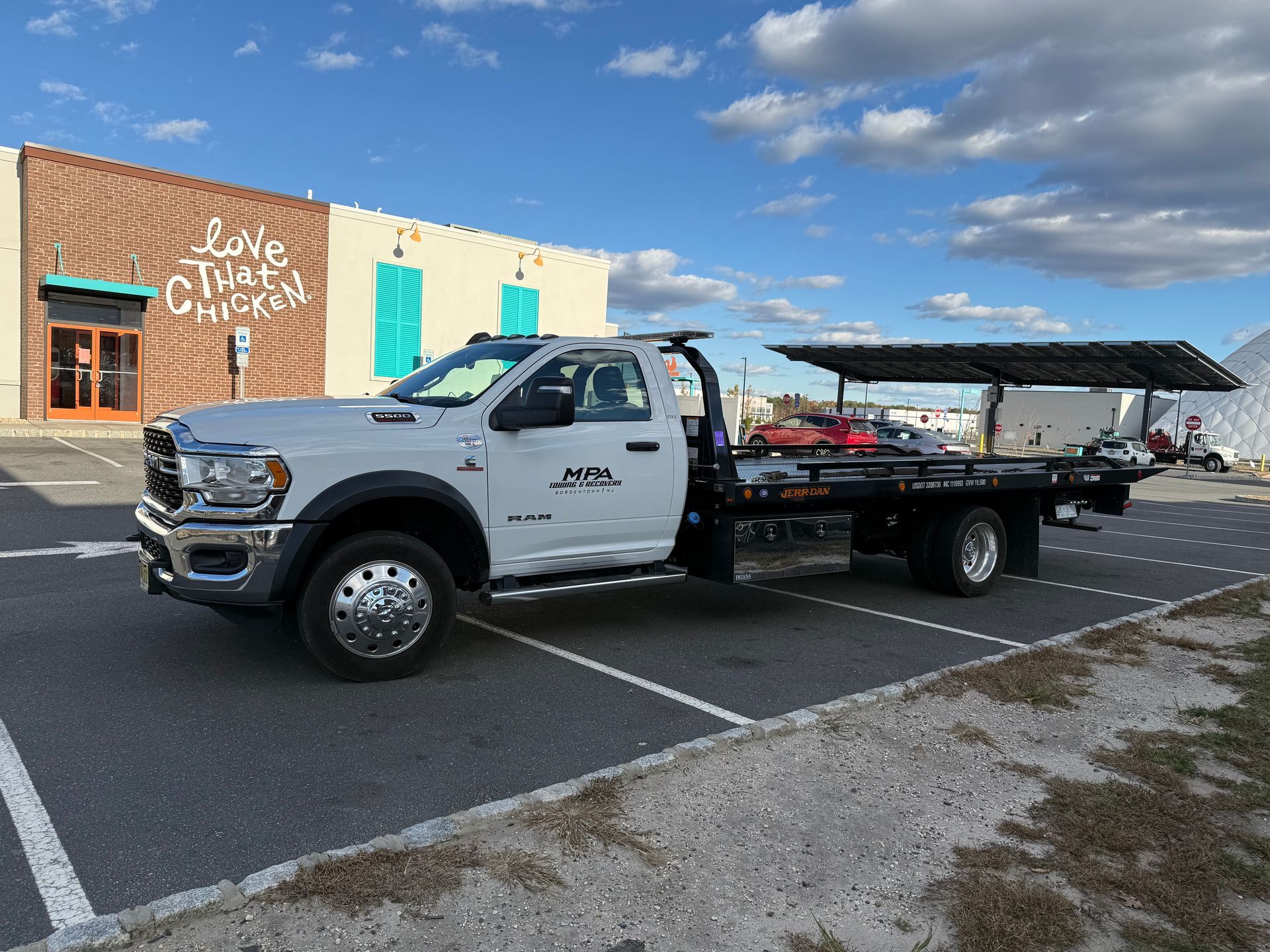
Loading an EV onto a flatbed solves the problem by removing it entirely. All four wheels sit on the deck, off the pavement, the whole way to wherever the car is going. No rotation, no regenerative current, no motor spinning against its will. It's the one towing method that works the same way across nearly every EV on the road, regardless of trim, software version, or whether the tow mode even exists on that particular model.
Wheel-lift towing — the two-wheels-up, two-wheels-down setup common for gas cars — carries the same core problem an all-wheel-drive gas vehicle has, just with higher stakes. Two wheels still turn, the motor still spins, and depending on how the EV's drive system is laid out, that can be enough to cause damage even though half the car is off the ground. A flatbed sidesteps the guesswork.
The Extra Weight Changes the Math, Too
Battery packs are heavy. A midsize electric sedan can weigh over a thousand pounds more than its gas-powered equivalent, with most of that weight sitting low in the floor pan. That changes how a recovery crew calculates ramp angle, tie-down points, and axle load on the flatbed itself — equipment rated for a compact gas car isn't automatically rated for the EV version of that same body style. It also changes stopping distance and weight transfer during the tow, which matters more than usual on the ice that builds up on the 295 overpasses through a Mercer County winter.
A Damaged Battery Changes the Recovery, Not Just the Drive There
After a collision, or if the battery pack has any visible damage, the entire calculation shifts. Federal guidance for tow and recovery operators treats a high-voltage EV battery as fully energized and potentially dangerous regardless of whether the car powers on or the dashboard stays dark. Exposed orange cabling, cracked battery housings, and areas marked with high-voltage warning labels all get a wide berth until the vehicle is confirmed safe.
A crew approaching a disabled EV usually comes in from the side rather than straight on, partly because there's no engine noise to tell you whether the car is actually "running." Lithium-ion battery damage doesn't always announce itself right away, either — a pack that looks stable at the scene can develop problems hours or even days later as internal cells slowly fail.
That delay is the reason for one hard rule:
if you smell something burning, hear popping, hissing, or gurgling from underneath the car, or see smoke of any kind after a crash, get everyone a safe distance away and call 911 before you do anything else. Don't try to move the vehicle yourself, and don't let a tow crew without EV-specific training near it. A damaged lithium battery can reignite even after it appears to have stopped, sometimes long after the tow truck would normally have already left the scene.
Cold Central Jersey Winters Make This More Common Than You'd Expect
Range drops in cold weather for every EV on the market, sometimes by a meaningful chunk, because the battery chemistry simply works less efficiently below freezing. Combine that with slush and road salt working into charge ports and sensor housings, and a Trenton or Hightstown cold snap tends to bring a noticeable jump in EV roadside calls. A trip that comfortably fit the range estimate in October can come up short in January, and drivers who haven't dealt with an EV through a Jersey winter yet are often caught off guard the first time it happens.
What to Do the Moment Your Electric Car Won't Move
Get the hazards on and stay in the vehicle if you're anywhere near live traffic — a stopped car on the shoulder of a road like Route 130 or 295 is safer with you inside it than standing next to it. Skip the DIY fixes. Don't try to push or roll the car by hand on any kind of grade, since the same regenerative current that can damage a motor during a tow can happen at walking speed, too. And don't let anyone hook up a strap or dolly without asking first whether your specific model has a documented tow procedure. Wait for a flatbed. It's slower to feel like relief in the moment, but it's the version of this story that doesn't end with a second, bigger repair bill a few weeks later.
Frequently Asked Questions
Can I have my EV towed with a rope or strap in an emergency?
No. A rope or strap tow keeps all four wheels on the ground and turning, which is exactly the scenario that risks motor and drivetrain damage on most EVs. It's not a safe shortcut even for a short distance, and most manufacturers explicitly warn against it in the owner's manual.
Does every electric car have the same no-neutral problem?
Most do, though the details vary by manufacturer and model year. Some EVs include a software tow mode that acts like neutral for short, low-speed moves, but it isn't standard across the industry, and it's not something a stranded driver should count on figuring out from the shoulder of the road.
My EV's screen is dead — how would a tow crew even know if it has a tow mode?
An experienced crew checks the manufacturer's published guidance for that specific model rather than relying on the car's own display, since a dead 12-volt battery often means a blank screen anyway. When there's no clear answer, flatbed towing works regardless, which is why it stays the default.
How is towing a hybrid different from towing a full electric car?
Hybrids vary more, since some retain a traditional transmission with a real neutral and others use an EV-style drive unit without one. The safest approach is to treat any hybrid the same way as an EV until you've confirmed otherwise, because guessing wrong carries the same drivetrain risk.
Will towing my EV the wrong way void the manufacturer's warranty?
It can. Drivetrain damage traced back to an improper tow — wheels down when they should have been on a flatbed — is the kind of thing a manufacturer can point to when reviewing a warranty claim. It's one more reason the tow method isn't a detail worth leaving to chance.
The Right EV Tow Protects More Than Time
An electric car that dies on the shoulder asks for a different response than the gas vehicle beside it. The single-speed drive unit, the absence of a true neutral, and the heavy battery riding low in the floor all point toward one answer, which is a flatbed with every wheel lifted off the pavement. Getting that part right is what keeps a dead battery from turning into a fried inverter and a repair estimate that dwarfs the problem you started with.
MPA Towing & Recovery
has spent Over a decade handling roadside calls across Bordentown and Hamilton, NJ, long enough to watch
electric vehicles shift
from rare to routine on local roads. That experience shapes how a crew reads a stalled EV, from checking manufacturer guidance for a hidden tow mode to keeping a wide berth around a battery pack that may have taken a hit. Method matters as much as speed here, and knowing the difference is what quietly protects the car.